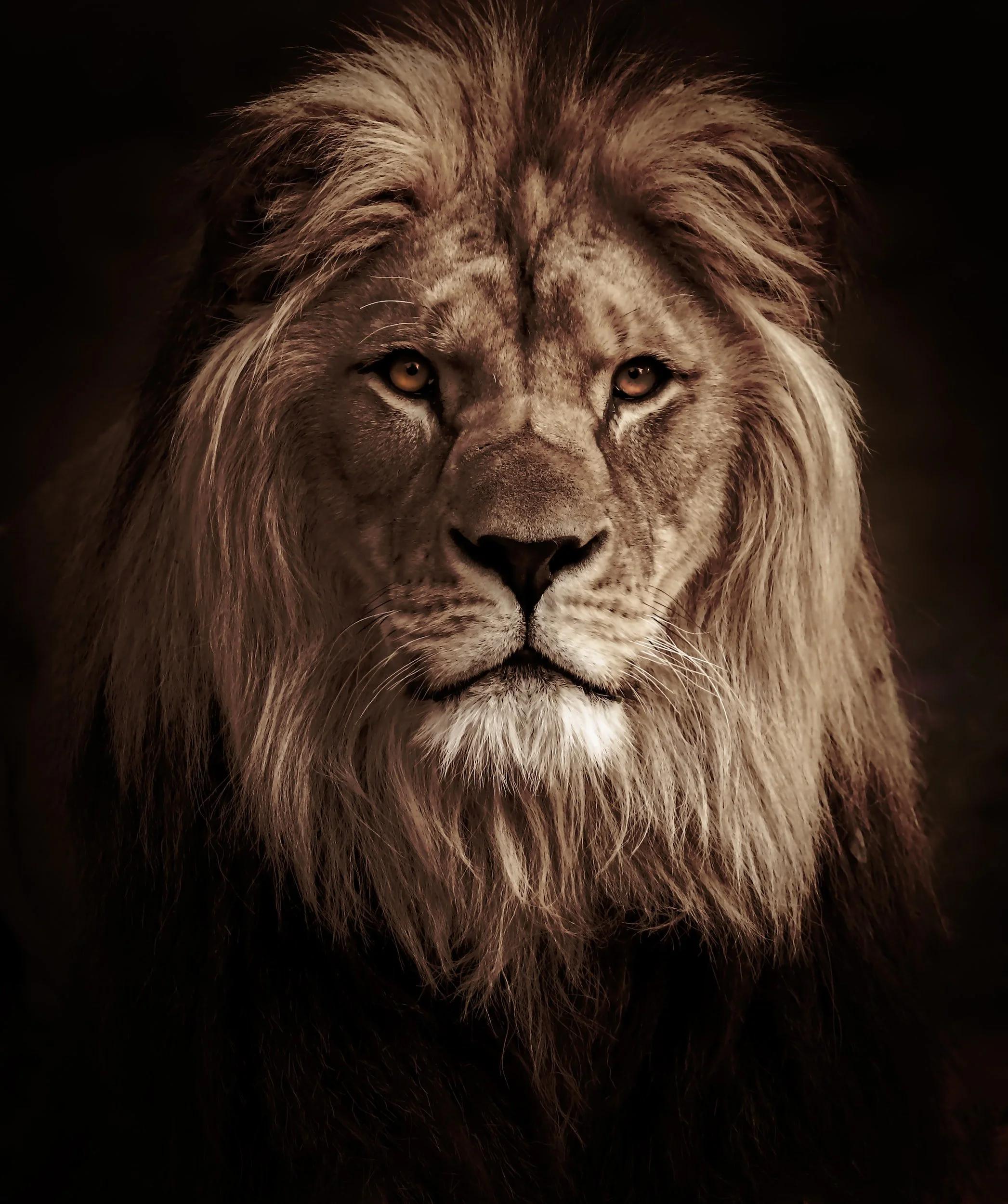
LION
MY PERSONAL STORY
I am a daughter of Lions. And a Lioness mother. With a father-line carrying the last name Van Leeuwen: “from the Lions”, or “of the Lions”.
Lion medicine is in my blood.
And yet, for many years, that powerful solar creature's majesty frightened me. I was reluctant to embrace her power. Probably because it is the masculine energy in my mother line. The fire-power. The raw strength. The fierce engine behind feminine superpowers I had also been struggling with for decades. Full expression. Passion. Heart-led fire that felt too big, too much, too bright.
My grandfather was the Van Leeuwen. The named lion, the patriarch, the one whose name said everything about strength and lineage. But more and more I realise how my grandmother — a Sagittarius, like me — was the one the whole family actually moved around. She was the center, the engine, and the entrepreneur, even in her era.
My mother is a Leo. Sovereign, magnetic, strong-willed, a force of nature that fills any room she enters. Growing up inside that energy I swung between being burned by it and standing in awe of it. I am a Sagittarius. The archer. The one who carries fire differently. Not as a sovereign center but as a directed flame that travels further. Same fire. Different expression.
I am not only a daughter of Leo’s, but also a mother of one.
My son is a Leo. And so the lineage continues.
LION ENERGY
Lion is connected to our yang power. Solar energy. Fire. Fierce, strong, deliberate.
And yet, there is a yin core we often forget, or overlook.
Yes, Lions roar, but only when they need to.
Yes, they can kill easily, but only when they need to.
Male lions sleep and wait and watch. And then awaken only for what is truly necessary for the survival of the pride. Lion power is not rash or unthought. It is deliberate and decisive. The king of the savannah — not the jungle, he doesn't even live there — who rules not by bullying or relentless effort, but by presence. By energy.
By being the one who holds the boundary so everything inside it can thrive.
When I stopped fearing that energy and started looking at what Lion actually does — in the wild, in the pride, in the long arc of ecosystems — everything shifted.
Because the story we tell about Lion is almost entirely wrong.
THE LION
Lion is the only big cat that lives in community. Every other member of the cat family — leopard, tiger, cheetah, jaguar — lives alone. They hunt alone, move alone, raise young alone.
Lion is the exception. The anomaly. The one who chose the pride.
A pride is not a harem. It is not a hierarchy of one. It is a living, breathing ecosystem of related females — mothers, daughters, sisters, grandmothers — who stay together for life, hunt together, raise each other's cubs together, and make decisions together. The female lines are unbroken.
The lionesses are the core. They are the continuity. They are what makes a pride a pride.
The males rotate. A coalition of males — usually brothers — holds a territory for two to four years before they are challenged and replaced. They come in, they protect the territory with their presence and their roar, they hold the boundary. And then they move on. Or they are moved on.
The females remain.
The lionesses do more than ninety percent of all hunting. They hunt collaboratively, with a precision that is nothing short of strategic. Each lioness has a favoured position — flank, centre, pursuit. They communicate without words, through body, through movement, through reading each other in real time. They coordinate ambushes across open ground to bring down animals three times their size. They feed the entire pride, every time, with what their collective intelligence makes possible.
And then they nurse each other's cubs. When lionesses in a pride give birth — which they often do simultaneously, their cycles synchronized. They nurse communally. Any cub can drink from any mother. The survival of the young is a shared responsibility, not an individual one. No cub is left to fail alone if the pride can help it.
The oldest, most experienced lioness leads. Not through force, but through the quiet authority of accumulated wisdom. She knows the territory. She knows the seasons. She knows when to move, when to wait, when to hunt and when to rest. The pride follows her — not because they must, but because she has earned it, over years, through showing up, through feeding them, through knowing.
She does not roar the loudest. She knows the most. That is what makes her queen.
THE KING — AND WHAT WE GOT WRONG
We named him king. We put his image on coats of arms, on thrones, on the flags of nations. We called him the king of the jungle while he doesn't even live in jungles; he lives on open savannah, in plain sight, in community.
For thousands of years, the lion has been the symbol of royalty. In ancient Mesopotamia, the Ishtar Gate of Babylon was lined with lions in glazed blue tile: protectors of the goddess, symbols of divine power. In Egypt, the goddess Sekhmet - lioness-headed, daughter of Ra, breathing fire upon the enemies of the pharaoh - was one of the oldest and most powerful deities in the entire pantheon. She embodied destruction and healing simultaneously. The scorching sun and the cooling rain. She was the one who flooded the Nile. She was the one who held the balance between life and death.
In Persia, the lion and the sun appeared together on royal emblems — power married to light, courage married to illumination. In medieval Europe, lions filled the heraldry of every noble house, every royal coat of arms. England's three lions. Scotland's rampant lion. The Lion of Judah. Across civilization after civilization, in cultures that never touched each other, the lion appeared as the mark of sovereign authority.
But here is what those civilizations encoded, even when they did not fully understand it: the lion that guarded the temple gates of Babylon was Ishtar's lion. A goddess's lion. In Egypt it was Sekhmet — the lioness — who held the power, not a male deity. The sphinx guarding the pyramids has a lion's body. The oldest lion carvings in human history, found in caves in Europe over thirty thousand years old, show lions in community — not alone, not dominant, not king over all. Together.
We took the symbol of communal feminine sovereignty and turned it into a symbol of lone masculine dominance. We gave the crown to the one with the mane — the most visible, the most dramatic — and called him king. And we forgot to look at what was actually happening in the pride.
The male lion is not lazy. That is also too simple. He patrols vast territories. He absorbs the threat so the lionesses do not have to. When a rival coalition challenges the pride, it is the males who take that fight — and the cost is brutal. His mane is not vanity; it protects his throat in combat. His roar carries eight kilometres across open savannah, announcing the pride's presence, holding the boundary, warning what approaches. He is doing something real and important.
But he is not running the pride. He is protecting the container so the pride can run itself.
This is divine masculine energy to its core. Protect, provide, Procreate.
He holds the protector energy, so the pride can survive, and thrive.
That distinction matters enormously. There is a difference between the one who guards the gate and the one who tends the fire inside. Both are needed. Both are sacred. The error was in deciding that the gate-keeper was the king, and forgetting that the fire-keeper was the queen.
He roars so she can hunt in silence. She hunts so the cubs survive. The cubs grow into the next generation of the pride. This is not hierarchy. This is ecosystem.
THE CIRCLE OF LIFE — AND WHAT IT ACTUALLY ASKS
Lion does not kill indiscriminately. This is one of the things that is most misunderstood about apex predators. They do not hunt out of cruelty or excess. They hunt what is available, what is weakest, what has reached the end of its cycle. They take the sick, the old, the ones whose time has come. And in doing so, they keep the herd strong. They keep the ecosystem in balance.
Remove the lion from the savannah, and the prey population explodes, overgrazes the land, strips the vegetation, collapses the water sources, and takes the entire ecosystem down with it. The lion is not the predator threatening the balance. The lion is the balance. Her presence is what makes the whole thing work.
This is the medicine of the circle of life that is hardest for us to hold. The predator is not the enemy of the ecosystem. She is its guardian. Her willingness to kill what is done — what has completed its cycle, what no longer serves the health of the whole — is what allows new life to come through. Death is not failure here. Death is part of the system's intelligence. And the one who can discern when something is complete, and act on that discernment without flinching, is performing one of the most essential functions in the entire web of life.
The lioness does not hesitate when she hunts. She does not apologize. She does not hunt more than the pride needs. She reads the herd, selects with precision, moves with full commitment, and feeds her community. Then she rests. Then she plays with the cubs. Then she grooms her sisters. The killing is one part of a full life — not the whole of it, not the center of it, but the necessary function that makes the rest possible.
What would it mean to hold that in our own work and leadership? To be willing to name what is complete. To end what has served its cycle. To act with the lioness's precision — not out of aggression, but out of care for the health of the whole. To understand that our willingness to kill what is done is not violence. It is stewardship.
She does not kill because she is ruthless. She kills because she is responsible for the living.
THE LION ACROSS CULTURES
In almost every civilization that encountered the lion — in reality or through trade and story — she became a symbol of sovereign power. But look more carefully and you find that the oldest lion deities were female.
Sekhmet in Egypt": lioness goddess, daughter of the sun, healer and destroyer, keeper of cosmic balance.
Ishtar in Babylon: goddess of love and war, depicted standing on lions, pulled by lions, the most powerful deity in the Mesopotamian pantheon.
Durga in India: riding a lion, wielding ten weapons, the embodiment of Shakti, the divine feminine creative power that underlies all existence.
Cybele in ancient Anatolia: the great mother goddess, enthroned between two lions, ruler of wild nature and protector of cities simultaneously.
The lion was, first, a goddess's animal. The symbol of the feminine force that holds the power to create and destroy, to feed and to end, to protect fiercely and to love without condition.
It was later, much later, that the lion became the king's symbol. The male ruler's emblem. The heraldic device of noble houses and warrior kings. The lion was borrowed from the goddess and given to the sovereign. And something essential was lost in that translation.
What was lost was the understanding that true sovereignty. The kind that keeps an ecosystem alive, that holds a pride together across generations, that feeds the young and protects the vulnerable and knows when to kill and when to rest — is not a performance of power. It is the patient, fierce, collaborative, discerning practice of responsibility.
That is what the lioness knows. That is what the oldest lion deities embodied. That is what the Van Leeuwen lineage was named for, even if it took the women in the family to actually live it.
WORKING WITH LION
Work with Lion when you are being asked to lead.
Not perform leadership, but actually hold the pride. When the health of the whole depends on your willingness to be present, to discern, to act, to feed what needs feeding and end what is complete.
Work with her when you are navigating the balance between masculine and feminine energy in yourself and in your work. When you are learning the difference between the roar that holds the boundary and the hunt that feeds the community. When you are learning that both are needed, and neither alone is enough.
Work with her when you are being called into ecosystem responsibility. When your work is no longer just about you, or your clients, or even your community — but about the health of a larger field. When you sense that your presence or absence actually changes what is possible for the whole.
Work with her when something needs to end. When you can feel that something has completed its cycle and you are hesitating; softening the truth, delaying the necessary, avoiding the kill out of misplaced kindness. The lioness teaches that the most loving thing is sometimes the most decisive thing. That clarity is care. That ending what is done is how you make space for what is next.
Work with her when you are ready to take your place in the pride. Not above. Not below. In your position — the one that only you can hold — coordinated with the others, each doing what she does best, the whole stronger than any one of you alone.
Work with her when you need to remember that sovereignty is not solitary. That the queen does not rule alone. That the pride is the point.
Lion’s message to me was:
“You were not named Van Leeuwen by accident. Neither were you born a Sagittarius inside a lion lineage by accident. The archer carries the lion's fire further than the lion can travel. That is also medicine. Stop playing small, or solo. Show up, in your full strength. and do what needs to be done to feed the children.”
What is her message to you?