
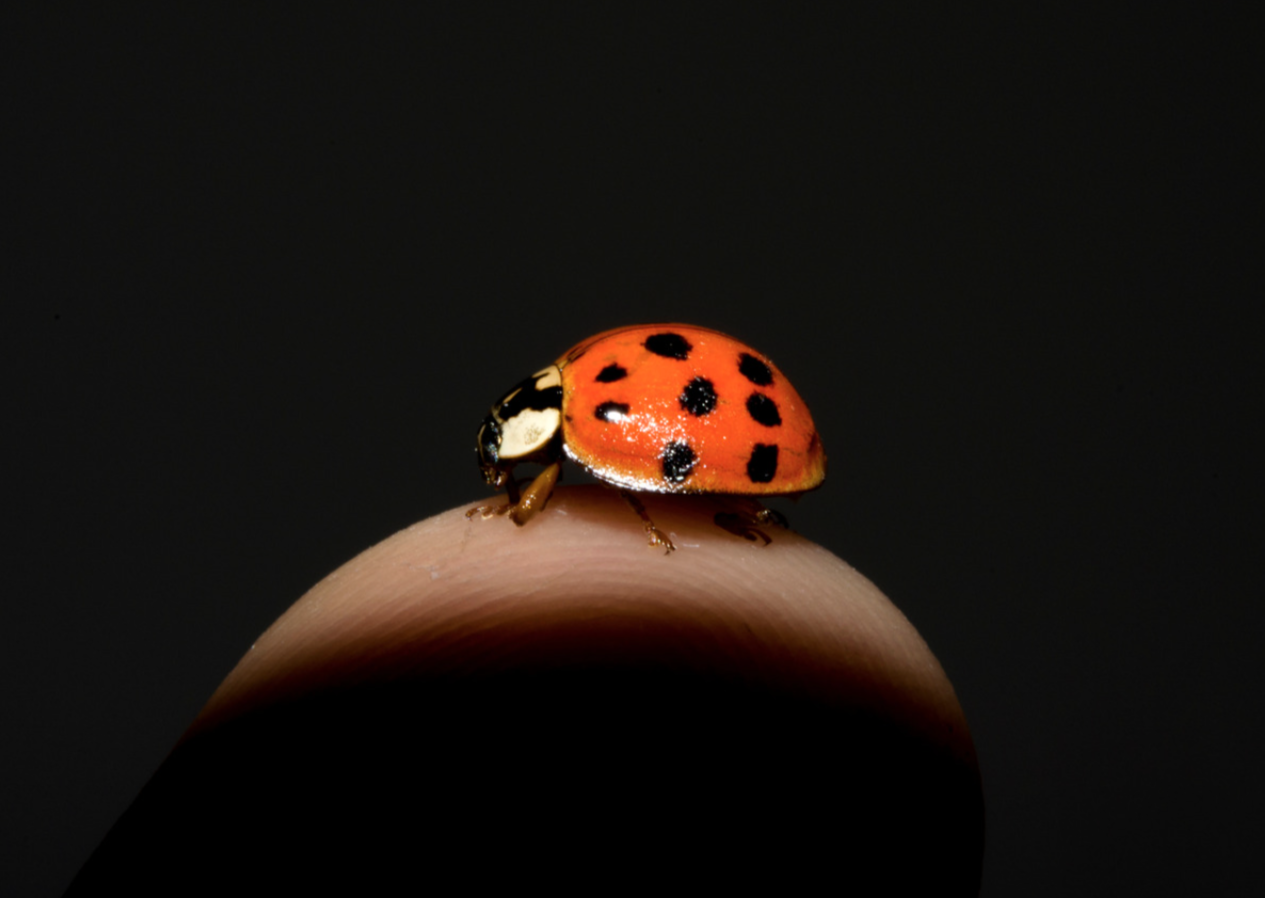
Ladybug
MY PERSONAL STORY
I chased them as a child. Tried to capture and keep them. Of course I did. As a child I always felt a close bound with nature. Animals have always been messengers to me. Friends. Neighbours. I loved ladybugs. So I caught them and put them in jars. Added flowers. Added aphids, the small soft insects they eat. I made them a world. I wanted to keep them.
They always left.
Not dramatically. Not in protest. They simply moved on. Unhurried, undisturbed, entirely themselves following their own path. They just flew away the moment they were ready. The jar meant nothing to them. My wanting meant nothing to them.
This, I would learn much later, is her medicine. To be fully present. To receive fully. And then to move — because she was never yours to keep.
THE LADYBUG
There are over 6,000 species of ladybird — or lady beetle, or ladybug — found on every continent except Antarctica. She is ancient. The ladybird family has existed for roughly 148 million years. Long before we were here to name her after our goddesses, she was already doing her work.
What most people do not know is what she looks like before she becomes herself. The larva — the stage before the red and the spots — looks nothing like the adult. She is dark. Spiky. Something between a tiny crocodile and an alligator. Unrecognisable. Voracious. At this stage she eats more aphids than she ever will as an adult — hundreds in a matter of weeks — before she attaches herself to the underside of a leaf and dissolves.
When she emerges from the pupa, her shell is pale. Soft. Almost translucent. She is vulnerable for hours while her exoskeleton hardens and her colour deepens into the red we know.
That red is not decoration. It is armour. A warning. A sovereign statement that says: I taste of something you do not want. Do not mistake my beauty for softness.
When truly threatened, she performs what biologists call a reflex bleed — she releases a small amount of her own blood through her joints. Yellow. Pungent. Repellent. She does not attack. She does not flee. She bleeds her own essence as a boundary, and it is enough.
In winter, ladybirds hibernate — not alone, but in gatherings of extraordinary scale. Up to thirty million ladybirds have been recorded in a single quarter acre. They return to the same location year after year. They wake, and they mate immediately.
She knows where to place her eggs — on the underside of leaves already inhabited by aphids. She does not search blindly. She reads the ecosystem and places the next generation precisely at the source of nourishment.
HER NAMES ACROSS THE WORLD
Every culture, on every continent, independently named her after a goddess or a divine feminine principle. This is not coincidence. This is recognition.
In English she is Ladybird — Our Lady's Bird, named for the Virgin Mary, who wore a red cloak. Her seven spots represent Mary's seven sorrows. In German she is Marienkäfer — Mary's beetle. In Dutch, Lieveheersbeestje — Dear Lord's little animal. In French, Bête à bon Dieu — God's little creature. In Russian, Bozhya korovka — God's little cow.
In Norse tradition she arrived from Freya — goddess of love, fertility, and sovereign feminine power — carried to earth inside a bolt of lightning. Not drifting gently down. Arriving with force.
In ancient Greece she was sacred to Aphrodite, goddess of love, considered a holy messenger between the divine and the earthly. The Greeks called her a carrier of love and prosperity, a sign that the goddess was near.
In Celtic tradition she was an oracle. She was also a protector — of children especially — a sign of spiritual guidance in uncertain times, a harbinger of good harvest. The Celts believed that if a ladybird flew away, she never forgot her birthplace and could always return. She carries memory of origin.
In Japan she is called Red Girl — Tenktochu — and is associated with heaven, celestial bodies, and the afterlife. A messenger between worlds. A carrier of good harvests and academic wisdom — abundance and intelligence, together.
In China her name is 瓢虫 — piáo chóng — the ladle insect, named for the dome of her body. The cup. She is a symbol of love, harmonious relationship, and emerging spiritual power. The five-spot ladybird specifically is known as the five victory, representing courage, love, happiness, wisdom, and fertility — held together in one small, red form. She brings the energy of good fortune not as passive luck but as active, living power.
In Slavic tradition she is a direct messenger to the gods. You whisper your wish to her, release her, and she carries it to where you cannot go.
She has been, across every culture: healer, protector, oracle, love messenger, divine envoy, sovereign sign.
The thread that runs through all of it: she arrives as an answer. She is sent. And she cannot be kept.
LADYBIRD TEACHES US
"I do not come because I am wanted, I come because I am invited. Quietly. resonating with the quiet energy, the frequency of wisdom ready to be released. I don’t stay because I am asked to stay. I do not land because you are ready. I land because the field calls me, and I answer.
You tried to keep me in a jar once. You brought me flowers. You brought me what you thought I needed. It was a loving thing to do. But I was not made for jars. They kill me. And your love for me, however real, does not change my nature.
This is the first thing I teach: not everything sacred can be contained. Some medicine arrives, does its work, and moves on. Your task is not to hold it. Your task is to be present enough to receive it fully while it is here.
I am grace. But I am not softness. Look at what I was before I became beautifully red: dark, unrecognisable, consuming everything I needed to become myself. Do not skip over your own larval stages because they do not look like what you thought transformation would look like. Honor that, yes, but don’t stay there, move on, at some point, to become a messenger.
As a messenger of the divine feminine across cultures and lineages, I carry the feminine principle. The restoring force. I arrive in places where the balance has been broken, where too much force and not enough grace has taken hold, where the garden has been taken over by what depletes it.
I do not fight what I find. I simply eat what does not belong. Quietly. Thoroughly. Without drama.
When I am threatened, I do not attack and I do not flee. I bleed my own essence as a boundary. This is sovereignty. Not aggression. Not collapse. The full, pungent, undeniable truth of what I am — offered as warning, offered as limit.
I am a messenger between worlds. Every culture that has ever watched me knows this. They whispered their wishes to me. They watched which direction I flew. They understood that I carry things to places the human mind cannot reach. Learn to work with me this way. Not as decoration. Not as symbol. As a living line between what you know and what is waiting.
And thirty million of us gather in the dark of winter, in the smallest of spaces, and remember together. We do not scatter. We do not hibernate alone. When it is time to rest and regenerate, we find each other. When we wake — we create immediately.
This is the council. This is what council women know in their bones.
I was sent by Freya in lightning. I carry Mary's sorrows and her grace. I am Aphrodite's holy messenger. I am Japan's red girl from heaven. I hold China's five victories, courage, love, happiness, wisdom, fertility, in one small body.
I arrive when the garden is under threat, to the people who have remembered how to ask for help.
I do not come because you are powerful enough. I come because you are open enough."
WORKING WITH LADYBIRD
Ladybird medicine is not about holding. It might not be about working at all.
It is about the quality of your reception.
Work with Ladybird when you are ready to receive grace without grasping it. When you are practicing sovereignty without hardness. When you are ready to be a messenger. To carry something between worlds, and trust that you do not need to know the destination before you fly.
Work with her when the garden of your life, your organisation, your field, has been overtaken by what depletes rather than nourishes. She does not come to fight the aphids. She comes to eat them. There where they are eating the greens, and killing the roses. Greedy, never satisfied. She eats them quietly. In her own time. Without being asked twice.
Work with her when you need to know the difference between a boundary and an attack. Between essence and aggression. When you need to remember that your truth, offered clearly, without apology, is enough.
Work with her when you are emerging from a larval stage that no one recognised as you.
When the colour is just beginning to come in. When the shell is still soft.
And work with her when you feel the pull of council, of gathering at scale, when something in you knows it is time to gather, to rest together, to wake together, and to create.
She visits you to bring the message of feminine wisdom
She lands on you when she chooses.
Be present enough to feel it.
And wise enough not to close your hand.